
The Second International Symposium on Climate and Environmental Changes and Civilization Evolution along the Silk Road(First Circular)
Dear Colleagues,
The Second International Symposium on Climate and Environmental Changes and Civilization Evolution along the Silk Road will be held at Bishkek, Kyrgyzstan during September 28 to October 1, 2026.The Symposium will bring together experts, researchers, and scholars all over and serve as a platform for discussion and exchange of ideas on varied aspects of Climate and Environmental Changes and Civilization Evolution along the Silk Road provided by it.
The Symposium at Bishkek will be organized by:
1)Institute of Geology, National Academy of Sciences of the Kyrgyz Republic
2)Institute of Earth Environment, Chinese Academy of Sciences
The Symposium at Bishkek will be co-organized by:
1)Shaanxi Belt and Road Joint Laboratory on Central Asia Extreme Climate
2)State Key Laboratory of Loess Sciences
3)Association for Trans-Eurasia Exchange and Silk Road Civilization Development
4)Research Center for Ecology and Environment of Central Asia (Bishkek)
5)Xi’an Institute for Innovative Earth Environment Research
The theme of the Symposium “Climate and Environmental Changes and Civilization Evolution along the Silk Road” will provide a platform for exchanging ideas, sharing innovative research and fostering collaborations across diverse disciplines. As is customary, the Symposium will comprise keynote presentations, session presentations, panel discussions, and other related activities. The registration fee of the Symposium is 400 dollars. The planned field excursions to three important geological and archaeological sites in Kyrgyzstan with the tentative price 200 dollars will offer participants an additional and enriching experience.
The host city Bishkek, is the capital of Kyrgyzstan. Its history dates back to around 5000 BC, and it is known as the “Colorful City of Art”, boasting a rich cultural heritage along the Silk Road. The Symposium will be held in the Main Building of the National Academy of Sciences of the Kyrgyz Republic, Bishkek, Kyrgyzstan. We therefore feel confident that the participants will find their visit, academically enriching, culturally delightful and socially engaging.
This circular provides the preliminary outline of the program, broad scientific themes and other information of relevance to plan your visit. Should you be interested in attending the Symposium, we would be pleased to invite you to submit an English abstract of 300–500 words and send to mail: wangyaqin@ieecas.cn or r.t.orozbaev@gmail.com, in accordance with the Symposium theme, by July 31, 2026. Upon successful review and approval by the Organizing Committee, an official invitation letter will be issued.
Once again, we offer o warm invitation and will welcome the privileged and honour of hosting you to Kyrgyzstan.
Symposium Organizing Committee
Institute of Geology
National Academy of Sciences of the Kyrgyz Republic
July 10, 2026
Symposium Organizing Committee
Organizing Chair
Prof. Aizek Bakirov: aizek.bakirov@gmail.com
Prof. Liangcheng Tan: tanlch@ieecas.cn
Organizing General Secretary
A.P. Yaqin Wang: wangyaqin@ieecas.cn
Prof. Rustam Orozbaev: r.t.orozbaev@gmail.com
Scientific Themes:
1. Past climate and environmental changes in the Silk Road region and their driving mechanisms
2. Climate-environment changes and the evolution and collapse of ancient civilizations along the Silk Road
3. Climate-environment changes and regional sustainable development in the Silk Road region
4. Interdisciplinary exchange for early-career researchers along the Silk Road
Post-Symposium Field Excursion (September 30 to October 1, 2026)
Principal Investigator: Rustam Orozbaev
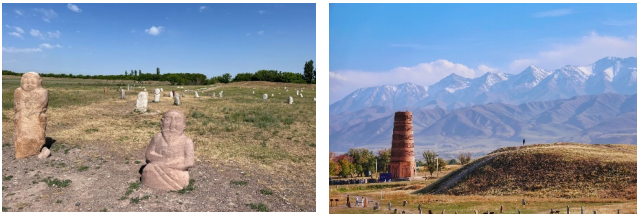
1. City Site at Ak-Beshim and Burana Tower
The Ak-Beshim site preserves the ruins of ancient city Suyab, a major Silk Road entrepôt from the 6th–11th centuries, revealing Buddhist, Nestorian, and Manichaean remains that illuminate Central Asian religious syncretism. This site is one of the most famous archaeological sites in Central Asia and in 2014 was included in the UNESCO World Heritage List as one of the cultural values of the Silk Road. According to Chinese sources, the great Chinese poet Li Bai was born in Suyab. The nearby Burana Tower, a surviving minaret of the 11th-century Karakhanid capital Balasagun, offers critical evidence of early Islamic architecture and medieval urban planning in the Tian Shan region.
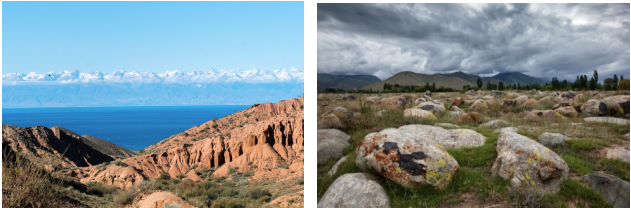
2. Issyk-Kul lakeside terraces and Petroglyphs Openair Museum
The Issyk-Kul lakeside terraces record Pleistocene-Holocene lake-level fluctuations and tectonic uplift, offering a rare archive of Central Asian paleoclimate and basin evolution. The nearby Open-Air Museum of Petroglyphs,often called the “Stone Garden,” is a 42-hectare archaeological site located just northwest of Cholpon-Ata, Kyrgyzstan. It features over 5,000 glacial boulders containing ancient petroglyphs, prehistoric stone circles, and Turkic balbals (stone warrior figures) dating from the 2nd millennium BCE to the 4th century CE.
附件下载: